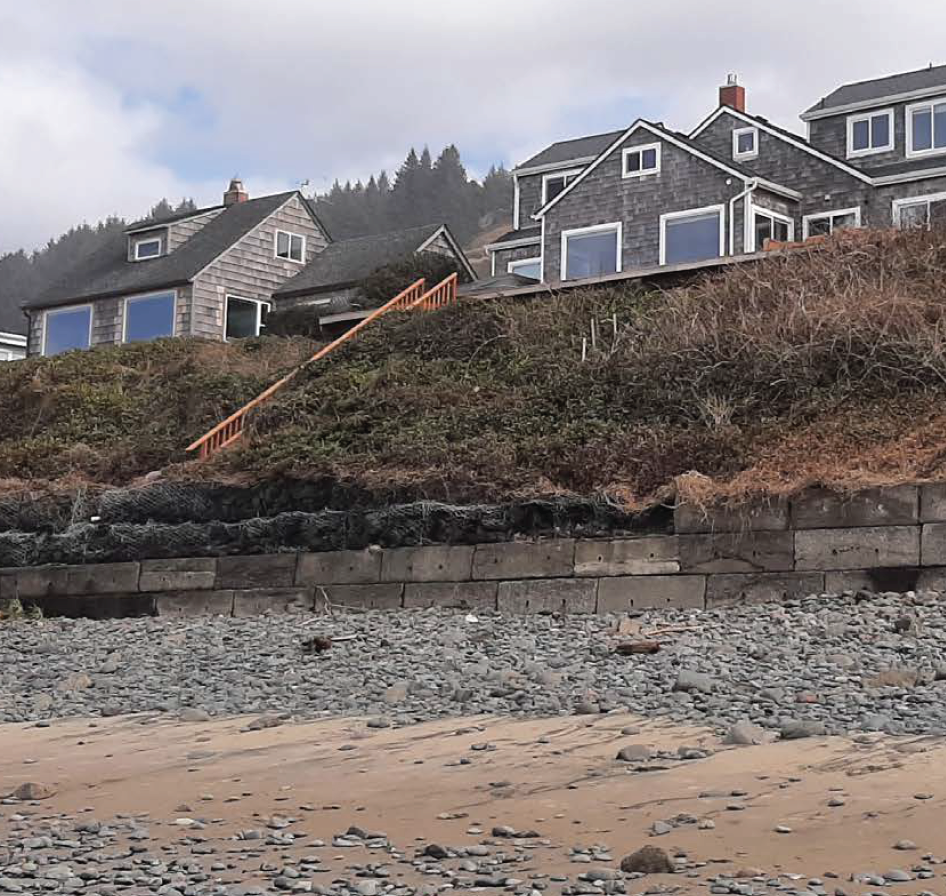
 Statewide Planning Goal 18 focuses on conserving and protecting Oregon’s beach and dune resources, and on recognizing and reducing exposure to hazards in this dynamic environment. Goal 18, Implementation Requirement 5, limits the placement of beachfront protective structures to those areas where development existed prior to 1977. This policy effectively places a cap on the amount of ocean shore that may be hardened, and thus limits the cumulative impacts of such hardening. Shoreline armoring fixes the shoreline in place, traps sediment, and causes scouring and lowering of the beach profile. These actions can result over time in the loss of Oregon’s public beaches.
Goal 18 restricts shoreline armoring with the statement “Permits for beachfront protective structures shall be issued only where development existed on January 1, 1977.” However, the goal does not specifically define the phrase “beachfront protective structure” (BPS). Currently, the determination of whether a structure is or is not a beachfront protective structure is made on a case-by-case basis by permitting agencies and local governments. The following definition for a beachfront protective structure was agreed by a DLCD focus group in 2019:
“A static structure that is intended to remain in a fixed position with the purpose of redirecting wave energy and to minimize or eliminate coastal erosion risk to development. BPS are purposefully constructed and intended to maintain that form over time. This includes, but is not limited to, rip-rap revetments, seawalls, groins, breakwaters, jetties, bulkheads, geotextile sandbags, sand burritos, gabions, and concrete or mortar reinforcement such as shotcrete. Beachfront protective structures do not include dynamic treatments such as sand nourishment, cobble revetments, and similar non-structural or nonfixed erosion mitigation measures.”
 To assist coastal practitioners in consistently applying the beachfront protective structure definition, the focus group recommended that DLCD put together a guidebook on common erosion control measures in Oregon and how they are regulated. The Guidebook on Erosion Control Practices of the Oregon Coast is designed to be a resource for coastal practitioners and community members looking for more information on Goal 18 and erosion control. The guidebook is a comprehensive overview of erosion control practices and their regulation on the Oregon coast. It includes a definition of a beachfront protective structure and clarifies what erosion control mechanisms on the Oregon coast are and are not beachfront protective structures. The guidebook also covers the main policies and land use goals relevant to the Oregon coast, typical and atypical permitting processes for erosion control, and detailed information about erosion control mechanisms viable on the Oregon coast.